


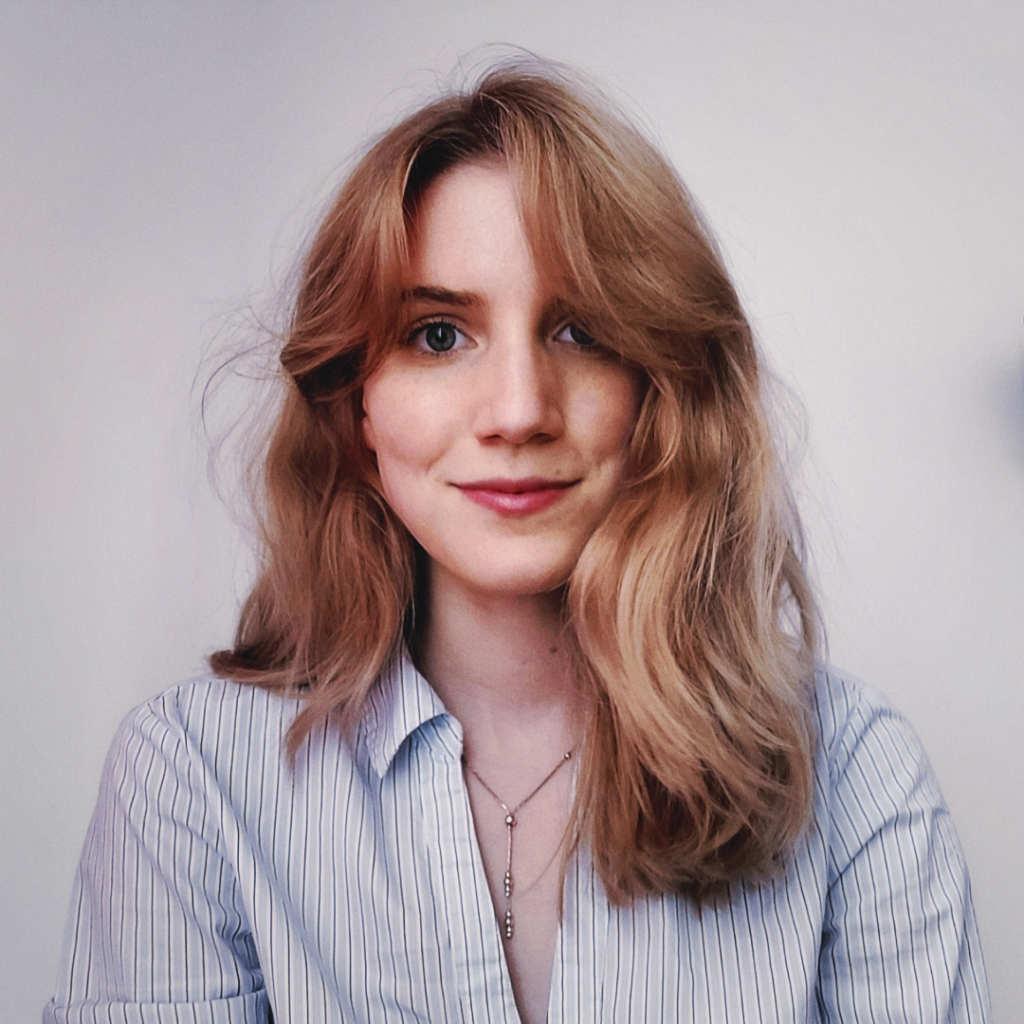
Annával 2 éve ismerkedtünk meg. Önkéntes koordinátorunk volt 2022-ben az Art Market Budapest-en, majd ugyanitt 2023-ban az Inside Art project menedzsereként dolgozhattunk vele.
Az általunk első ízben szervezett Art Weekend Budapest központi kiállításának kiállítója és kurátora is volt egyben. 2022-ben végzett kísérleti filmesként a Falmouth University-n, Angliában.
We got to know her as a versatile and open-minded artist, and we were curious about her thoughts and plans regarding art. It was an honor and very inspiring to work with Anna.
Ő.E. és Ny.Sz.: Mesélj nekünk arról, hogy mikor és hogyan kezdtél el a művészettel foglalkozni! Milyen hatások értek gyermekkorodban és azután, ami a kísérleti filmhez, mint médiumhoz vezetett?
J.A.: Nagyon tipikus és kissé közhelyes mondat, ami azt hiszem, sok művész szájából elhangzik valamikor, hogy születésem óta ezzel foglalkozom, de van benne igazság. A szüleim mindig is nagyon szerették dokumentálni a családi életünket, hogy fennmaradjanak az emlékek, így hát megmaradt rengeteg felvétel a gyerekkoromból. Látszik, hogy már kicsi, beszélni még alig tudó gyerekként is érdekelt a kamera, mint eszköz – varázslatos volt, és rendkívül érdekesnek tartottam, hogy egyszerre nem létezhettem a kamera mögött és előtt. Ez volt az első találkozásom ezzel a médiummal.
I attended the Andor Ilona Singing and Music Primary and Elementary School of Arts, which, as its long name suggests, meant that I was involved in arts education from the beginning of my school years. I think it was clear to my parents that I wasn't going to be a professional athlete, so they enrolled me here. In my second year, I started learning to play the harp, but I soon realized that it wasn't actually the music itself that brought me joy, but rather the creative environment that surrounded me in music class, dance class, and the choir where I sang. I never thought about the fact that this wasn't a normal thing, that it wasn't part of everyday life for children to do these things.
High school was a sharp change for me in that, even though I had applied to an English-focused class, it was actually a very strong, mainly science-oriented school.
Here I was confronted with the reality that not everyone exists in this little bubble of music and dance that I had been in before, and because of this, it was a rather difficult period in my life. I had a hard time finding my place, but even during this time, my interest in the arts continued, and I was particularly interested in fashion and textile art. Literature has always been close to my heart, and I loved reading and writing, which is how I ended up at the talent camp organized by ELTE Eötvös Collegium. For a short time, I attended a drama club, took part in poetry recitation competitions, and enjoyed animation, so I was really interested in everything related to art. Towards the end of my teenage years, however, I realized that none of the activities I mentioned were my path, but regardless, everything I tried was stored in my head, expanding the artistic palette or toolbox that I have been building on ever since. Film is actually one of the most complex artistic media, as it is built from elements of many other media and creates a completely new, audiovisual whole.
After finishing high school, my desire for discovery and adventure led me to the United Kingdom, where I graduated from Falmouth University in England with a degree in film, specializing in experimental film. I chose this institution because it offered me the opportunity to learn about and collaborate with other art forms, in addition to practical and theoretical education. Incidentally, I was also attracted by the rural, coastal environment of England. As a resident of Budapest, I was curious to experience living in a completely different environment, in much closer contact with nature.
Perhaps it was when I arrived at university that I felt for the first time since elementary school that I had finally found a place where—there's an expression for this in English: find your people. At first, we looked at filmmaking through a wide lens, with everyone trying their hand at a little bit of everything, from editing to producing. It was very important to me that we also learned a lot about social science concepts and theories through film theory, such as feminism, intersectionality, gender theory, and colonization. Despite COVID, these years were very exciting and inspiring, and I felt at home with film as a medium from the very beginning. A particularly important moment was when I chose to specialize in experimental film in my second year, led by filmmaker Rachael Jones, who later became my mentor. She taught me how to work with analog techniques, including shooting video on Super 8 mm film and then developing it myself in the lab.
Despite discovering filmmaking, I remain open to all other media, and experimentation is also important to me from a multidisciplinary perspective. In May 2023, I created two paintings for an exhibition curated by Lenkey Viola Dóra at the Tér-Kép Gallery, in collaboration with Ács Kinga Noémi. I was curious to see if I could somehow convey the attitude I have towards filmmaking through another medium. I don't think I want to focus solely on film in the future, so these experiments are very important to me.
Ő.E.: During our previous conversation, you mentioned that you learned to draw. Was it at school or perhaps in some other way?
J.A.: I taught myself to draw. At school, I only took part in compulsory art classes, but during university I sometimes sat in on life drawing classes to do some studies. Just recently, I was wondering whether I should finally go to art school, or whether it's too late now.
Ny.Sz.: I don't think it's too late. But if you've found your own visual or graphic language, it might influence you a little. I realized that an experimental filmmaker works with a much smaller crew, so the film can be much more personal. The whole thing is much freer, of course. How should we imagine this, what is the process?
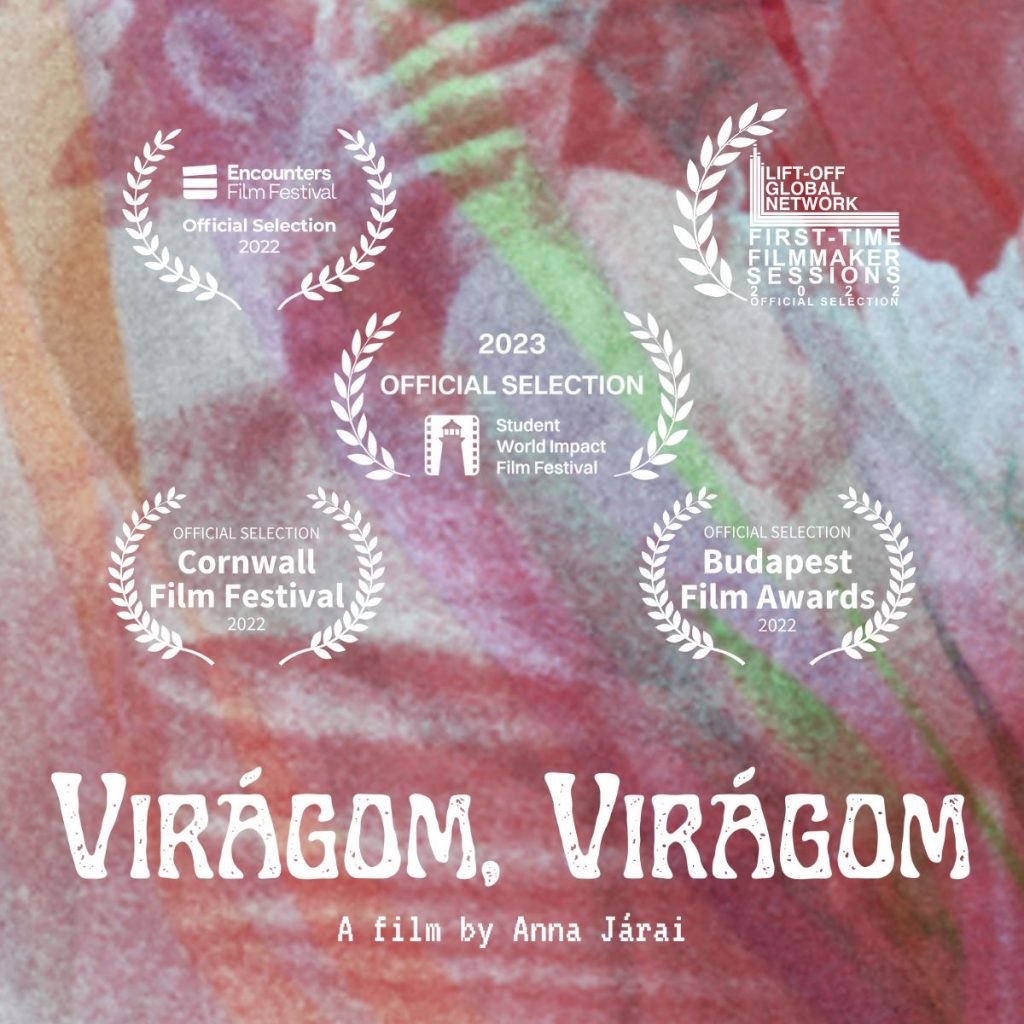
J.A.: I have an overview of every element of the creative process, and I do every element to some extent. In the case of my graduation film (Virágom, Virágom, 2022), I did the editing, I was the producer, I did all the background work, I shot it digitally and on 8mm film, which I also developed. The collaboration took place with the people appearing in the recordings, which was a relatively large group. Rachael accompanied the whole process, first as a consultant and then as a friend.
Ny.Sz.: Can you say a few words about your graduation film?
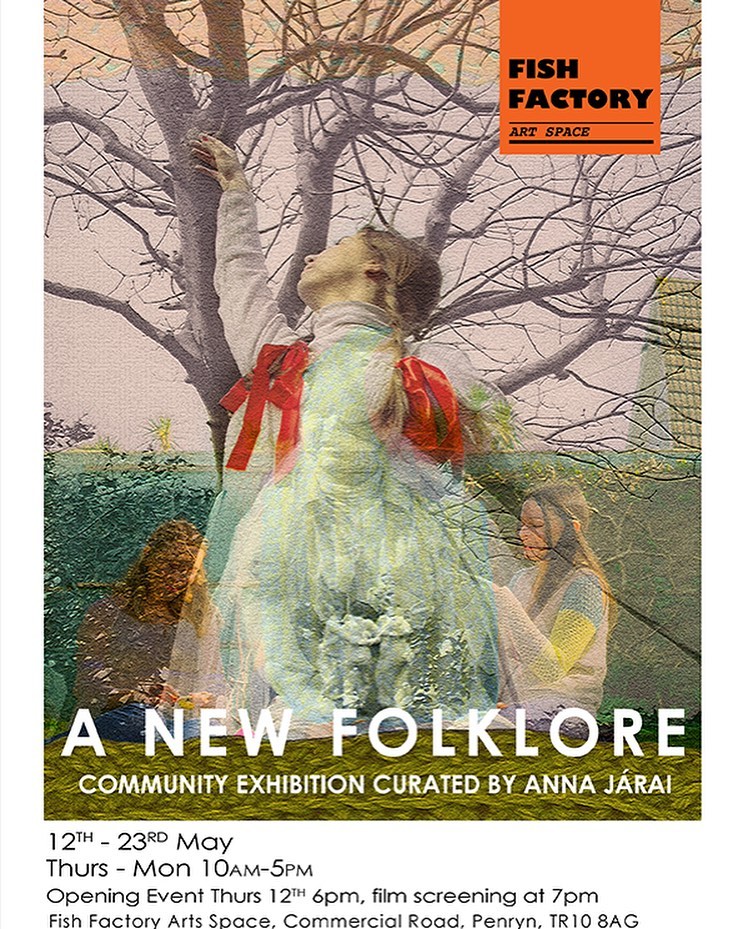
J.A.: It stems from my life abroad. I didn't exist in a Hungarian environment, so my Hungarian identity suddenly became an active factor in my identity, and that's why it started to preoccupy me. I became interested in why I had no connection to the otherwise very rich folk art background that exists in Hungary. It dawned on me that this was not only true for me, but for many other people, especially those of my age group. Or, if they do participate in things like folk dancing or folk music, they are reluctant to admit it (perhaps because of the political associations involved), which I think is a very absurd situation in itself. Basically, we are talking about artistic and cultural symbols, and I think that the word "folk" in folk art should refer to the entire people. I wanted to create a film that approaches and interprets traditions, such as the raising of the May tree, from a slightly different angle. Or, for example, in another scene, I drew a parallel between spinning and other similar folk crafts and the handicraft hobbies that are popular again today, such as crocheting and knitting.
A célom az volt, hogy eltávolítsam, azt a kontextust, amiben ezek a motívumok a kánonban létezhetnek és új kontextusba helyezzem őket – ezáltal rávilágítva azokra a szereplőkre, akik passzívan vettek részt ezekben a tradíciókban vagy sokkal kevésbé voltak/vannak reprezentálva az úgymond tradicionális kánonban. Ez volt az elképzelés mögötte és maga a megvalósítás az nagyon érdekes és hosszú folyamat volt.
Ő.E.: What festival did you send your film to?
J.A.: It was selected for quite a few places, but perhaps the biggest one was the Encounters Film Festival in Bristol, the UK's most prestigious short film festival, where the film was screened in the student section. My film was almost the only experimental one, and as it turned out, I worked with a much smaller crew than the others, so I had to manage a different budget – all of which only reinforced my surprise and honor at being selected.
Ő.E.: If you explored your identity and culture as a Hungarian in England, did the same question arise among your friends?
J.A.: We talked quite a lot with those who participated in the film in one way or another, who came from my circle of friends or became friends through the film. It was also very interesting that one of the dancers was a Polish girl, and during the choreography it turned out that there are many similar steps in Hungarian and Polish folk dances. I find it very interesting that, depending on where you are and what environment you are in, you can construct completely different narratives from these small elements. Ny.Sz.: Are there any new ideas or thoughts that are occupying your mind at the moment?
J.A.: The story of my great-grandmother (on my mother's side) has been with me for years, but I only began to consciously engage with it a year and a half ago. We don't know much about her, only fragments of information remain. She was a woman of peasant origin who never married, but nevertheless had three children. We also know that she was once admitted to a local mental hospital, where her own daughter took her. We don't know exactly why she was admitted, or whether it was justified at all. We don't know when she died or where she is buried; I have not been able to find her grave to this day. This is a larger-scale project, preceded by thorough and very personal research, and I would like to present it in the form of a separate exhibition.
Ő.E. and Ny.Sz.: Who are the artists whose work has been influential in the context of your own art?
J.A.: I would highlight the work of Pipilotti Rist, Tacita Dean, and Jodie Mack in particular; I find their use of the medium very inspiring. I have always loved Impressionist painting, but the most influential painter for me is Hilma af Klint, who was essentially the first figure of abstract painting. Moving away from the visual arts, the books of Ali Smith and Hermann Hesse have also had a great influence on me.
Ő.E. and Ny.Sz.: Thank you very much for talking to us, Anna! We wish you every success in the future!